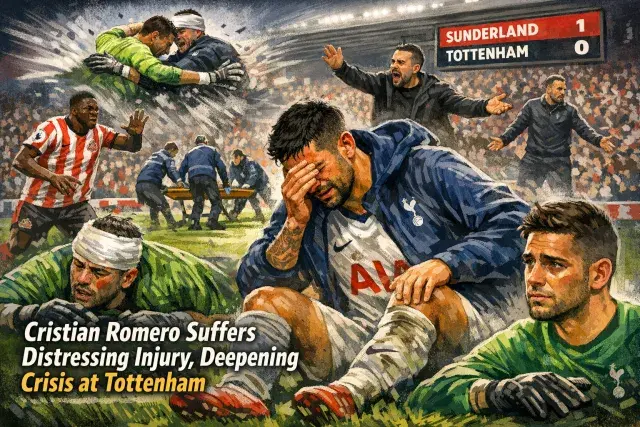
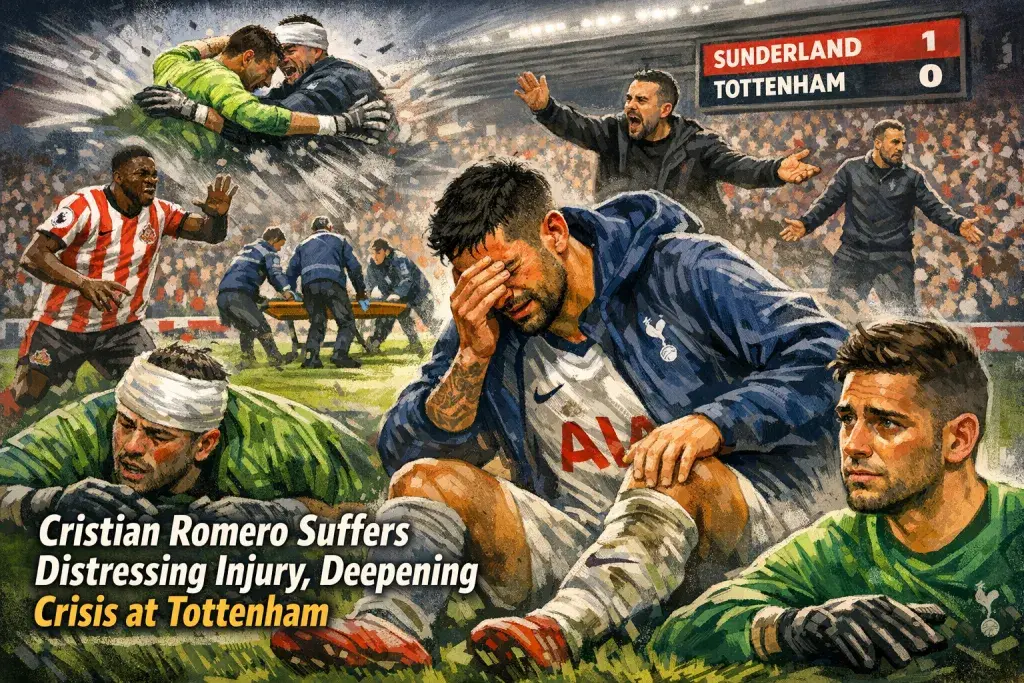
Cristian Romero left the field visibly overwhelmed on Sunday after a forceful collision with his own goalkeeper, Antonin Kinsky, during Tottenham's 1-0 defeat away to Sunderland — Roberto De Zerbi's first fixture in charge of the north London side. The Argentine international, already carrying the psychological weight of a recent concussion episode, was unable to continue and was seen in tears as he was guided toward the touchline, a sight that drew an immediate and sympathetic response from those in attendance at the Stadium of Light.
The Anatomy of a Dangerous Collision
The incident unfolded shortly after Sunderland had taken the lead through a deflected Nordi Mukiele strike in the 61st minute. Romero, attempting to recover a loose ball under pressure, appeared to be nudged by Sunderland forward Brian Brobbey, lost his footing, and collided directly with Kinsky. The force of the contact left both men on the ground for several minutes, with Sunderland midfielder Noah Sadiki urgently signalling for medical staff to enter the field. Backup goalkeeper Brandon Austin was being prepared as a precaution while medical personnel assessed Kinsky, who ultimately continued after receiving protective head bandaging.
Collisions of this nature — two large bodies travelling at speed, converging from different directions — carry a well-documented risk of concussive and orthopedic injury. The unpredictability of such incidents, combined with the instinctive, unguarded movements involved in recovering loose possession, makes them among the more hazardous occurrences in contact sport. Romero's distress upon leaving the field, and his inability to compose himself, suggested the injury was not superficial.
A Pattern of Head Injuries That Warrants Attention
This is not the first time Romero has been involved in a serious head-related incident in recent weeks. The 26-year-old was substituted during a high-stakes Champions League fixture against Atletico Madrid last month following a concussion-related concern. That context makes Sunday's collision notably more troubling. Repeated head impacts — even when separated by weeks rather than days — raise legitimate questions about cumulative neurological risk, a subject that governing bodies and medical professionals have been grappling with across contact disciplines for well over a decade.
The understanding of concussion in professional environments has evolved considerably. Current protocols in elite competition generally mandate that any player showing signs of concussion be withdrawn from activity and assessed through a structured return-to-participation pathway. The emotional response Romero displayed on Sunday, while not necessarily diagnostic in itself, indicates a level of physical and psychological distress that warrants careful and unhurried medical evaluation before any return is considered.
An Afternoon That Exposed the Fragility of a Club in Crisis
The injury unfolded against a backdrop of mounting institutional pressure. Tottenham entered Sunday's fixture sitting 18th in the Premier League table, two points from safety, and with a new head of operations in De Zerbi attempting to stabilise a deeply unsettled environment. The defeat was compounded by a VAR reversal that overturned a penalty decision after referee Rob Jones was directed to review footage of a challenge involving Randal Kolo Muani. The decision provoked visible fury on the Spurs sideline and added to a sense that the afternoon had unravelled comprehensively.
Romero has been one of the few unambiguously dependable figures in Tottenham's defensive structure in recent seasons. His potential absence for any extended period would significantly narrow an already thin margin for recovery. The club faces Brighton at home next Saturday — a fixture that, given the current standings, carries considerable consequences for their survival in the top flight. Losing one of their most experienced defenders to injury at this particular moment adds a dimension of difficulty that tactics and preparation alone cannot easily absorb.
What Comes Next for Romero and for Spurs
The immediate priority is straightforward: a thorough medical assessment, with no pressure placed on timeline. The football calendar's demands have historically worked against proper injury management in elite environments, but the combination of two head-related incidents in close succession demands that Romero's welfare take precedence over any competitive scheduling consideration. Kinsky's status will also need monitoring; head bandaging on a goalkeeper who remained on the field is not, in itself, reassurance of full fitness.
For a club already under severe pressure, Sunday represented a convergence of misfortunes — a contested refereeing outcome, a debut defeat for their new leader, and the distressing exit of a key defensive figure. Whether Romero's injury proves short-term or more serious will become clearer in the coming days. What is already clear is that Tottenham can ill afford to lose him, and that those responsible for his welfare face a decision that goes beyond the immediate demands of the table.